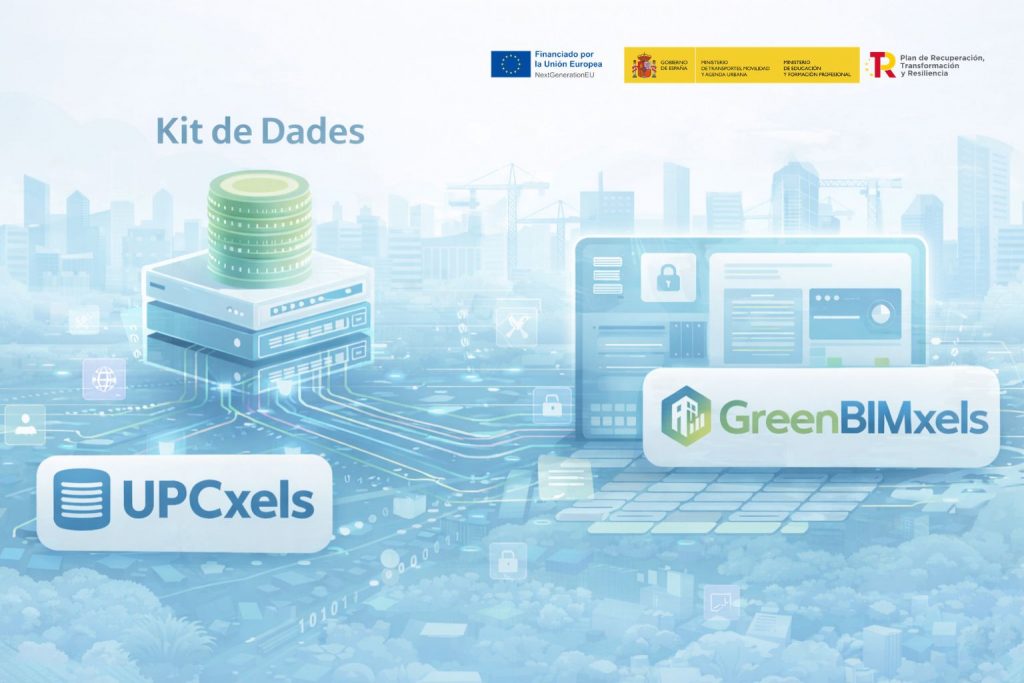
The digitalization of the construction sector is not only about incorporating new technologies, but also about sharing data in a structured, interoperable and useful way. In this context, at Coloma + Armengol we have taken an important step forward by being awarded the Data Spaces Kit, an initiative that allows us to advance in a key strategic line: transforming knowledge into reusable digital assets.
Our participation takes place within the GreenBIMxels (UPCxels) data space, an environment designed to facilitate secure, governed and efficient information exchange between organizations.
What is the Data Spaces Kit?
The Data Spaces Kit is an initiative promoted by the Spanish Secretary of State for Digitalization and Artificial Intelligence and the European Union, within the framework of the Next Generation EU program and the Recovery, Transformation and Resilience Plan.
Its objective is to foster the creation of collaborative data spaces, where different entities can share and reuse information under a clear legal framework aligned with European regulations (GDPR).
These data spaces enable:
- Improved operational efficiency
- Deployment of AI-based solutions
- Creation of new business opportunities
- Promotion of innovation in the sector
In short, this represents a step towards a data-driven economy applied to the built environment.
Our use case: a repository of BIM models in IFC format
The project developed by Coloma + Armengol focuses on the creation of a repository of BIM models in IFC format. However, it is not just a collection of technical files, but a set of structured, standardized and traceable digital models designed to be reused by different stakeholders in the sector.
This repository includes models covering multiple disciplines such as architecture, structures, building services and furniture.
The goal is to provide a coherent and representative database that can be effectively used in different professional contexts.
Why is it relevant?
IFC model repositories already exist, but they are often heterogeneous collections, typically created for demonstrations or specific use cases.
Our approach focuses on:
- Common naming and structuring criteria
- Consistent metadata
- Quality control
- Models designed for multiple uses
This helps reduce interoperability barriers and enables applications in areas such as:
- Research and development (R&D)
- Specialized training
- Benchmarking of digital tools
- Cross-platform process validation
Development process
Throughout the project, we have worked across several areas to ensure the quality and usefulness of the models:
- Definition of data sets
- BIM modeling and technical review
- Cleaning and normalization of models
- Alignment with standards such as GuBIMClass
- Anonymization of sensitive data
- Enrichment with sustainability and Facility Management information
- Final validation before publication
This approach ensures that the models are not only accurate, but also interoperable and reusable.
Participation in GreenBIMxels: a strategic opportunity
Our participation in GreenBIMxels (UPCxels) allows us to be part of a growing ecosystem that promotes collaboration and data sharing as a foundation for innovation.
Our expectations are clear:
- Learn and collaborate with other industry stakeholders
- Explore new applied research opportunities
- Validate methodologies in real environments
- Contribute to the definition of open standards
At the same time, this experience enables us to open new lines of work related to:
- Interoperability
- Digital twins
- Specialized training
- Smart management of built assets
Participation in the Data Spaces Kit represents another step towards a more open, connected and data-driven construction sector.
Beyond the specific project, we see this initiative as an opportunity to actively contribute to the digital transformation of the sector, generating value not only for ourselves but for the entire ecosystem.
The challenge now is to consolidate these shared data spaces as a real and useful infrastructure for the industry.
