
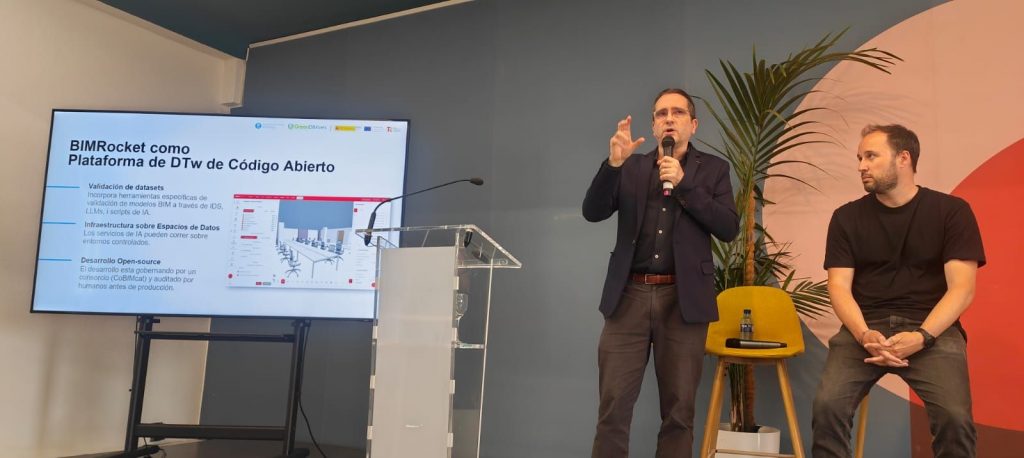
Last April, Madrid hosted the conference “AI and the Future of Data in Construction”, organized by buildingSMART Spain, establishing itself as one of the leading forums for understanding where the AECO sector is heading in terms of digital innovation.
The event brought together professionals and companies to discuss an issue that is no longer futuristic, but fully present-day: how to integrate artificial intelligence into BIM workflows in a useful, reliable, and scalable way.
In this context, the contribution by Eloi Coloma —together with Albert Solé— focused on the integration of natural language interfaces with digital twin platforms, emphasizing the direct relationship between data quality, interoperability, and the real capacity to apply AI effectively.
A paradigm shift: from digitalization to data intelligence
The sector is already digital… but not necessarily intelligent
Throughout the conference, a shared reality became evident: the AECO sector has made a significant leap in digitalization thanks to BIM, yet it is still in an early stage regarding the intelligent exploitation of data.
BIM is based on the generation of coordinated, coherent, and computable information throughout the entire lifecycle of a building. However, this information is often:
- Not fully structured
- Not semantically interoperable
- Not prepared to be consumed by AI systems
This is the real bottleneck.
AI applied to the AECO sector: opportunity and risk
One of the key messages of the conference was clear: AI does not solve data problems — it amplifies them.
This means:
- High-quality data → better decisions
- Inconsistent data → amplified errors
In this sense, AI becomes a powerful tool, but also a risk factor if not properly managed.
OpenBIM as infrastructure for AI
Real interoperability, not only technological interoperability
The role of openBIM —promoted by buildingSMART International— was central throughout the event.
It is not only about using open formats such as IFC, but about ensuring:
- Semantic interoperability
- Consistency in classification systems
- Information traceability
- Data governance
These elements are essential for AI systems to correctly interpret models.
IDS and IFC: towards verifiable models
The conference highlighted key developments in:
- IDS (Information Delivery Specification) to define information requirements
- IFC as a standard for data exchange
The combination of both enables progress toward models that are:
- Automatically verifiable
- Auditable
- Ready for AI integration
This approach aligns with BIM information management frameworks and the roles associated with data governance.
LLMs and natural language: a new interface for BIM
From querying data to conversing with the model
One of the most innovative aspects of Eloi Coloma’s presentation was the integration of openBIM models with LLMs (Large Language Models).
This approach makes it possible to:
- Query model information using natural language
- Access data without advanced technical knowledge
- Improve real-time decision-making
This shift transforms BIM into a more accessible and transversal interface.
Driving digital twins forward
AI integration also facilitates the development of digital twin environments, where model information is connected with operational and contextual data.
This opens new opportunities in:
- Asset management
- Real-time monitoring
- Energy optimization
- Simulation and predictive maintenance
Automation, validation, and human oversight
Practical applications presented
The conference included several real-world use cases demonstrating the immediate potential of AI:
- Automated IDS validation
- Assisted review of IFC models
- Classification and error detection
- Support for ISO 19650-aligned processes
These applications are not the future — they are already part of the present.
The irreplaceable role of people
Despite technological advances, one fundamental principle was strongly emphasized:
AI-generated results must still be audited and validated by humans.
This idea connects with a key statement made during the presentation:
Progress implies taking risks, but those risks must be managed responsibly and under control.
This requires defining processes, roles, and governance mechanisms capable of ensuring data quality at all times.
Roundtable discussion: governance, risks, and the future of data
The event also included discussion spaces addressing strategic questions.
Main shared reflections
- Data governance is more important than technology
- Interoperability is a requirement, not an option
- AI will accelerate processes, but it will not replace technical judgment
- Collaboration among stakeholders will be essential to create value
Immediate challenges for the sector
- Standardizing information
- Improving model quality
- Integrating data throughout the building lifecycle
- Training professionals in advanced digital environments
The buildingSMART Spain conference confirms that the AECO sector is at a turning point.
The technology already exists.
The real challenge is the data.
The combination of openBIM, information governance, and artificial intelligence has the potential to radically transform the way we design, build, and manage buildings.
But there is one essential condition: without high-quality data, there is no useful AI.
The future of the sector will not only be digital.
It will be interoperable, collaborative, and —above all— based on reliable data.